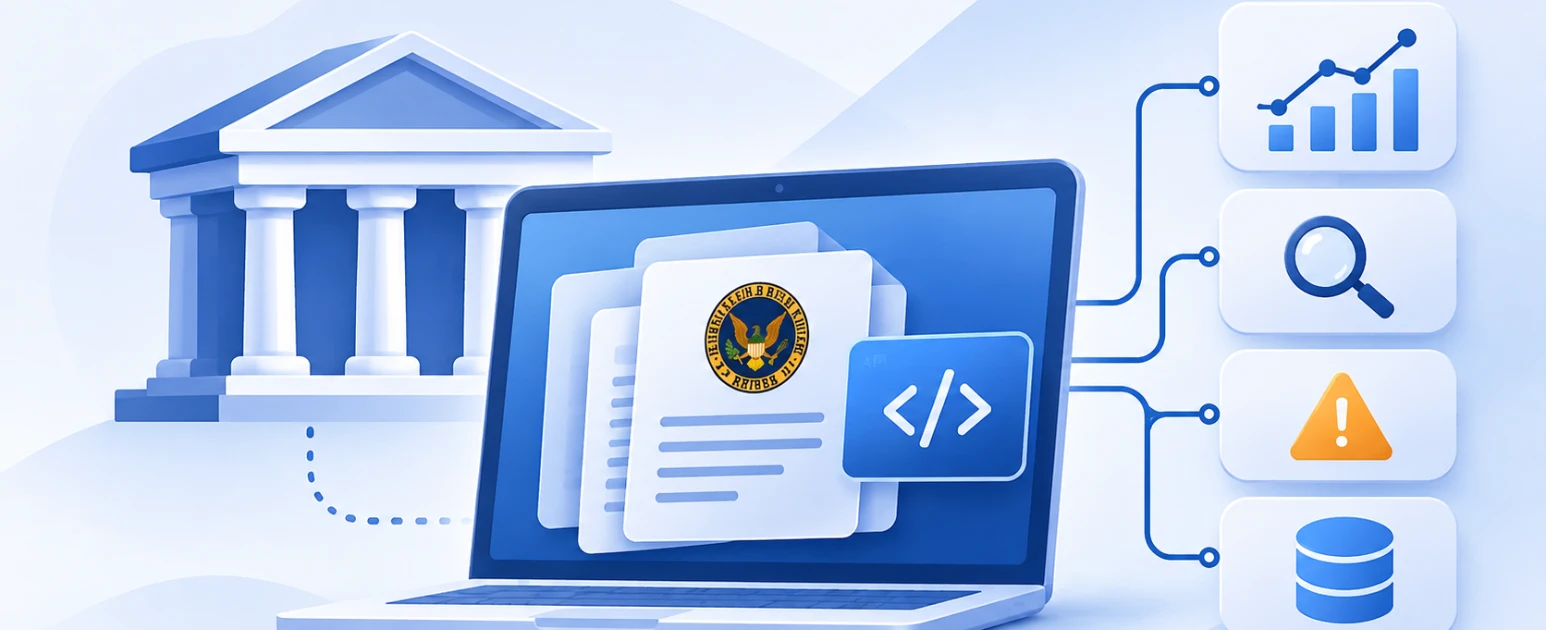
Banks need reliable financial information to assess borrowers, monitor corporate risks, and make informed decisions. However, collecting SEC filings manually becomes difficult when analysts must review disclosures from hundreds of public companies.
An SEC filings API helps banks automate access to corporate disclosures for credit risk assessment, loan underwriting, counterparty monitoring, M&A due diligence, investment research, and internal compliance reviews. It reduces repetitive data collection and gives banking teams a more consistent way to track financial information.
This guide explains six practical SEC filings API use cases for banks, the most relevant SEC forms, and how to integrate filing data into banking workflows.
What Is an SEC Filings API and How Does It Help Banks?
An SEC filings API allows banks to retrieve corporate financial disclosures electronically from the SEC's Electronic Data Gathering, Analysis, and Retrieval (EDGAR) system.
Banks use this information to review financial statements, assess corporate risks, and track changes in a company's financial condition. Instead of searching for each filing manually, their systems can retrieve relevant documents and updates through API requests.
The SEC's official EDGAR APIs provide free access to company submission histories and financial statement data in JSON format. Commercial SEC filings APIs can provide additional capabilities, such as standardized filing structures, advanced search, and historical document retrieval.
For banks, these capabilities support:
- - Automated filing retrieval: Access annual reports, quarterly reports, and material event disclosures.
- - Financial analysis: Review financial performance, debt levels, cash flow, and liquidity.
- - Risk monitoring: Track relevant disclosures from borrowers and counterparties.
- - Historical research: Compare financial information across reporting periods.
- - Workflow integration: Bring filing information into internal banking systems and research tools.
6 Practical SEC Filings API Use Cases for Banks
SEC filings APIs support six important banking activities, from corporate credit analysis to automated risk monitoring. Each use case relies on retrieving relevant public disclosures and making them available within existing banking workflows.
1. Corporate Credit Risk Assessment and Loan Underwriting
SEC filings APIs help banks retrieve financial reports needed to evaluate publicly reporting corporate borrowers.
A credit analysis system can request the latest 10-K and 10-Q filings using a company's ticker symbol or Central Index Key (CIK). Analysts can then examine reported revenue, debt, operating cash flow, and liquidity.
Banks can also use XBRL financial data to collect tagged financial figures for ratio calculations. For example, a credit team may compare debt-to-equity ratios across reporting periods after checking the underlying figures and accounting definitions.
API-based retrieval reduces manual document collection and helps analysts access consistent filing records. However, the reported information still requires verification before use in lending decisions.
2. Borrower and Counterparty Risk Monitoring
SEC filings APIs allow banks to monitor new financial disclosures from borrowers and counterparties through scheduled requests.
A bank can maintain a list of companies and query the API for recently published 10-K, 10-Q, or 8-K filings. Its monitoring system can compare new results with previously retrieved documents and flag relevant updates.
For example, a bank may run daily API checks for corporate borrowers. When a borrower publishes its quarterly report, the system retrieves the filing and notifies the credit monitoring team.
This approach supports ongoing risk reviews without requiring analysts to check every company's EDGAR profile manually.
3. M&A Due Diligence and Deal Evaluation
SEC filings APIs help investment banking teams retrieve historical financial disclosures during mergers and acquisitions.
Analysts can use company identifiers and date filters to collect several years of annual reports, quarterly statements, and material event disclosures. Full-text search can also help locate references to outstanding debt, litigation, material agreements, and disclosed liabilities.
For example, an investment banking team can retrieve an acquisition target's historical 10-K filings through an API. It can then search those documents for information relevant to financial due diligence.
This reduces document collection time and gives analysts organized access to public disclosures. Confidential deal information and independent due diligence remain necessary.
4. Investment Research and Securities Analysis
SEC filings APIs allow bank research teams to collect financial information for company comparisons, valuation models, and securities analysis.
Analysts can retrieve income statements, balance sheets, cash flow statements, and other disclosures from public issuers. They can then examine changes in earnings, profitability, leverage, and financial performance.
For example, an equity research team can compare reported revenue growth and operating margins across companies in the same industry.
Historical filing data also helps analysts examine financial trends across several years. Consistent data retrieval reduces manual research work and supports repeatable analysis.
5. Monitoring Material Corporate Events and Financial Red Flags
SEC filings APIs help banks identify corporate events that may affect credit exposure, investment positions, or counterparty relationships.
Form 8-K is particularly useful because it reports certain material corporate events between periodic filings. Banks can monitor these disclosures for developments that require further investigation.
Relevant examples include:
- - New financial obligations: Material debt agreements and certain off-balance-sheet arrangements.
- - Debt-related triggering events: Events that materially accelerate or increase financial obligations.
- - Financial statement restatements: Disclosures indicating that previously issued financial statements should no longer be relied upon.
- - Major corporate transactions: Material agreements, acquisitions, and asset disposals.
For example, an 8-K disclosure under Item 2.04 may indicate a triggering event affecting a company's debt obligations. A bank holding that company's debt can review the event and assess its potential exposure.
The SEC's Form 8-K guidance explains when these disclosures are required. Not every financial problem triggers an 8-K, so banks should not rely on event filings alone.
6. Internal Compliance Reviews and Risk Reporting
SEC filings API help bank maintain source-backed financial records for internal compliance reviews, audits, and risk reporting.
Banks often need to show which financial information supported a credit assessment or investment decision. Filing metadata, document dates, and accession numbers help teams trace information back to its original disclosure.
For example, an internal audit team may need to verify which annual report was available when a bank completed a corporate credit review. Historical filings and preserved source references can support that verification.
Banks can also incorporate relevant public-company disclosures into internal risk reports. However, SEC filings do not replace banking regulatory reports or satisfy compliance obligations on their own.
Which SEC Filings Can Bank Access Through an API?
SEC filings APIs provide access to several report types used in banking analysis. The most useful forms depend on the documents a bank needs for lending, risk monitoring, or investment research.
| SEC Filing |
Information Available |
Banking Use Case |
| 10-K |
Annual financial statements and business disclosures |
Credit assessment and due diligence |
| 10-Q |
Quarterly financial results and updates |
Borrower and counterparty monitoring |
| 8-K |
Material corporate event disclosures |
Event monitoring and risk reviews |
| 20-F |
Annual reports from foreign private issuers |
International company analysis |
| 6-K |
Updates furnished by foreign private issuers |
Cross-border counterparty monitoring |
| 40-F |
Annual reports from eligible Canadian issuers |
Cross-border financial research |
Banks can use API filters to retrieve these filings by company, reporting period, or form type. Availability varies by API provider.
How Banks Can Integrate SEC Filings APIs into Their Workflows
Banks can integrate SEC filings APIs into existing credit analysis, research, and risk management systems through a structured data retrieval process.
The integration should identify the correct companies, retrieve relevant documents, and preserve enough information for analysts to verify the results.
Identify Companies and Retrieve Relevant Filings
Banks should begin by mapping the companies they monitor to reliable SEC identifiers.
A company's Central Index Key (CIK) provides a consistent identifier for EDGAR filings. Banking systems can use CIKs, ticker symbols, filing types, and date ranges to request the appropriate records.
For example, a credit monitoring system can retrieve the latest 10-Q filings for selected corporate borrowers instead of searching every company filing.
Extract Financial Data and Monitor Filing Updates
Banks can use retrieved financial disclosures to update internal databases, financial models, and risk monitoring dashboards.
Structured financial statement data can support ratio calculations and historical comparisons. Banks can also configure scheduled checks or alerts when relevant filings become available.
For example, a system may flag a newly published 8-K for an analyst to review. The analyst can then decide whether the event affects the bank's exposure.
Quantillium's SEC Filings API provides standardized JSON responses, full-text search, filing metadata, and historical filings from 2015 onward. Its REST API supports integration with internal banking applications and research systems.
Validating Filing data and Maintain Source Records
Banks should verify financial information against original disclosures nefore using it in a credit or risk assessments.
Financial data may require adjustments for reporting periods, accounting differences, and subsequent amendments. Systems should also identify amended filings, such as Forms 10-K/A and 10-Q/A, when reviewing historical information.
Maintaining filing dates, accession numbers, and source document links helps analysts check figures and explain the information used in earlier decisions.
SEC Filings API Evaluation Checklist for Banks
Banks should evaluate an SEC filings API based on coverage, data quality, update speed, and integration requirements. These factors determine whether the service can support routine analysis and automated monitoring.
Use this checklist when assessing an API provider:
- - Filing coverage: Does the API support the required SEC forms, companies, and historical periods?
- - Data formats: Can it return full documents, structured metadata, and suitable financial data?
- - Update frequency: How quickly are new SEC filings available after publication?
- - Search capabilities: Can users filter by CIK, ticker, filing type, date, and document content?
- - Request limits: Can the API handle the bank's expected filing volume and retrieval frequency?
- - Amendment tracking: Can the system identify amended reports and preserve previous filing references?
- - Integration and security: Does it offer documented REST endpoints and appropriate API authentication?
Banks should also consider caching previously retrieved filings to reduce repeated requests.
SEC filings APIs primarily cover entities that submit reports to the SEC. Banks evaluating private borrowers may need additional financial records outside EDGAR.
Bottom Line
SEC filings APIs help banks automate corporate disclosure retrieval for credit risk assessment, counterparty monitoring, M&A due diligence, and investment research. Filing filters, full-text search, historical records, and structured metadata make financial information easier to access and analyze.
By integrating SEC filings APIs into existing workflows, banks can reduce manual research, monitor important disclosures, and maintain reliable source records. These capabilities support more efficient financial analysis and better-informed banking decisions.
Frequently Asked Questions
What Are the Main SEC Filings API Use Cases for Banks?
Banks use SEC filings APIs for credit risk assessment, loan underwriting, counterparty monitoring, M&A due diligence, and investment research. They also use them for automated filing checks and internal risk reporting.
How Do SEC Filings APIs Help Banks Assess Credit Risk?
SEC filings APIs retrieve corporate financial disclosures, including 10-K and 10-Q reports. Banks can review reported debt, cash flow, liquidity, and other financial information to support credit assessments.
Can Banks Automate SEC Filing Monitoring Through an API?
Yes. Banks can configure applications to check an API for newly published filings. Their systems can flag relevant reports and notify analysts when new disclosures appear.
Can Banks Extract XBRL Financial Data Through an API?
Yes. The SEC provides free APIs for selected XBRL financial facts in JSON format. Banks can use this information for financial analysis after verifying reporting periods, units, and accounting definitions.
Does the SEC Provide a Free Filings API?
Yes. The SEC offers free APIs for company submission histories and selected XBRL financial data. These APIs do not require authentication, although automated users must follow SEC access policies.