Difference Between Annual Filings and Annual Reports
Annual filings and annual reports serve different purposes. Understand compliance, data reliability, and when each document matters most.
Annual filings and annual reports are often used as if they mean the same thing. But they serve very different purposes.
The confusion usually comes from the fact that:
- Both are released once a year,
- Both contain financial information, and
- Both are referenced by investors, analysts, and the media.
In reality, one is a legally regulated disclosure submitted to authorities, while the other is a company crafted communication designed for stakeholders.
For compliance and risk teams, confusing the two can create gaps in regulatory oversight. For investors and data teams, it can result in decisions based on selective narratives rather than the full, regulated record.
This guide clearly explains the difference between annual filings and annual reports, what each document is used for, and when one matters more than the other.
By the end, you will know which source to trust for analysis, compliance, and data driven decision making.
What is Annual Filing?
An annual filing is a legally required disclosure that a company submits to a government authority, regulator, or corporate registry once per year. It contains detailed financial, operational, and governance information prepared according to regulatory standards, not marketing preferences.
Purpose and Legal Requirement
The primary purpose of an annual filing is regulatory compliance and transparency. These filings allow regulators, investors, lenders, and other institutions to evaluate a company’s financial health, risks, and governance practices.
Because they are mandated by law, annual filings follow strict rules around content, format, and deadlines, with penalties for inaccuracies or late submission.
Typical Contents of an Annual Filing
Annual filings usually include:
- Full financial statements, including balance sheets, income statements, and cash flow statements
- Notes to the financial statements
- Risk disclosures and legal contingencies
- Information on directors, officers, and ownership
- Governance and compliance related disclosures
The level of detail is intentionally comprehensive to support oversight and analysis.
- Statutory annual filings submitted to stock exchanges or financial regulators
- Annual returns filed with corporate registries in various countries
What is an Annual Report?
An annual report is a company prepared document that summarizes performance, strategy, and financial results over the past year. While it may be required in some jurisdictions, its structure and presentation are largely controlled by the company.
The purpose of an annual report is communication rather than regulation. It is designed to explain results, highlight achievements, and present the company’s narrative to shareholders, investors, employees, customers, and the broader public. The tone is typically explanatory and forward-looking.
Typical Contents of an Annual Report
Annual reports commonly include:
- Messages from senior leadership
- Business strategy and performance highlights
- Summarized financial results
- Visual charts and graphics
- ESG, sustainability, and corporate responsibility sections
(Verdict: Unlike annual filings, annual reports focus on clarity and storytelling, not exhaustive disclosure.)
Annual Filings vs Annual Reports
Aspect
Annual Filings
Annual Reports
Purpose
Meet legal and regulatory requirements. Provide a full and factual record of financial position and risks
Explain performance and strategy. Present the company story to stakeholders
Legal and regulatory requirements
Strictly regulated by authorities. Mandatory disclosures, fixed formats, firm deadlines. Penalties apply for errors or delays
Often required, with flexible structure and presentation. Limited regulatory enforcement
Audience and use cases
Regulators, institutional investors, analysts, banks, compliance teams. Used for risk assessment, due diligence, financial modeling
Shareholders, employees, customers, media. Used for investor relations and public communication
Format and structure
Standardized formats defined by regulators. Focus on consistency and completeness
Visual and narrative focused. Uses charts, summaries, and commentary
Data depth and reliability
Comprehensive, regulated, and verifiable data. Most reliable source for analysis and comparison
Summarized and selective information. Provides context rather than detailed analysis
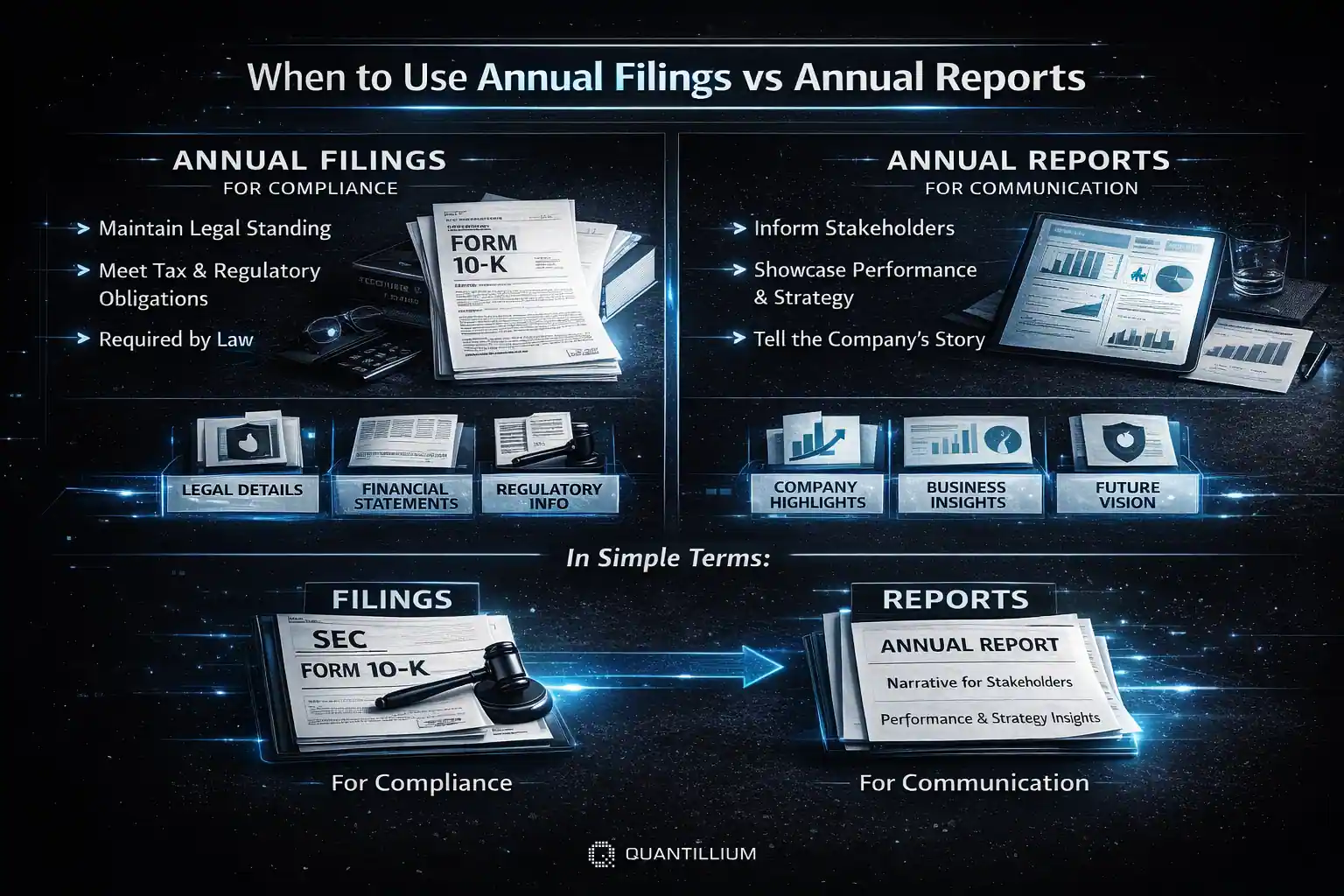
When to Use Annual Filings vs Annual Reports
Use annual filings such as SEC Form 10-K or statutory state filings to meet legal and regulatory requirements, maintain registration, and report required financial and corporate information to authorities.
Use annual reports to communicate performance, strategy, and vision to shareholders and other stakeholders, providing context and explanation beyond raw financial data.
In simple terms:
- Filings are for compliance
- Reports are for communication and transparency.
Use an Annual Filing When:
1. Maintaining legal standing You need to keep the company registered and in good standing with government authorities or corporate registries.
2. Meeting tax and regulatory obligations You are required to report income, financial results, and compliance information to tax authorities or regulators.
3. Required by law Public companies must submit regulated filings, such as Form 10-K in the United States, and many private companies must file annual returns in their jurisdiction of incorporation.
4. Information required
5. Legal company details, such as name, address, directors, and officers
6. Financial statements and disclosures
7. Compliance and regulatory information
Use an Annual Report When:
1. Informing stakeholders You want to provide investors, customers, employees, and the public with a clear view of the company’s performance and direction.
2. Supporting transparency and accountability You need to explain financial results, governance, and business decisions in a more accessible way.
3. Telling the company’s story You want to highlight achievements, challenges, strategy, values, sustainability efforts, and long-term vision.
4. Internal planning and review Management uses the report to assess performance against goals and support strategic planning.
Key Difference:
- Annual Filing: A legally mandated submission to government bodies for compliance, registration, and regulated data disclosure.
- Annual Report: A stakeholder-focused, narrative-driven document designed to explain performance, strategy, and overall business context.
Bottom Line
Annual filings and annual reports serve different roles. Filings exist for legal compliance and regulated disclosure. They provide complete, verifiable data used for risk analysis, audits, and financial modeling. Reports focus on communication. They summarize results, explain strategy, and present a curated view of performance for stakeholders.
If your work depends on accuracy, comparability, and regulatory trust, annual filings should be your primary source. Annual reports add context and narrative value, but they do not replace filings for compliance, due diligence, or data driven decisions. Knowing which document to rely on protects your analysis and reduces risk.
Quantillium simplifies access to annual filings at scale. Our API delivers standardized global filings, full document extraction, historical coverage, and daily updates across 60 stock exchanges. You spend less time collecting data and more time producing insights. Start a free trial, explore the API docs, or contact us to support your team.
What is the main difference between an annual filing and an annual report?
An annual filing exists for the law. Companies submit it to regulators or registries. It includes detailed, regulated financial and governance data. An annual report exists for people. Companies use it to explain results, strategy, and highlights with summaries and narrative.
Is an annual report legally required?
Often yes, but rules stay flexible. Companies usually must publish a report for shareholders, yet regulators place fewer limits on format and content.
Is a Form 10-K an annual filing or an annual report?
A Form 10-K is an annual filing. Companies submit it to the U.S. Securities and Exchange Commission. It contains full, regulated disclosures, even if companies reference it in annual reporting.
Are annual reports based on annual filings?
Yes. Most reports reuse data from filings. Teams summarize numbers, reorder sections, and add commentary or visuals for a wider audience.
How do annual filing requirements differ across countries?
Rules change by country. Differences include accounting standards, formats, languages, and deadlines. Cross border work becomes difficult without normalized data.
What happens if a company fails to submit its annual filing?
Penalties depend on location. Common outcomes include fines, late fees, trading suspensions, or loss of legal status. Missing filings also signal risk for investors.
Are annual filings always audited?
Most public companies include audited financials. Audit rules vary by country, company size, and listing status, so assurance levels differ.
How often do companies amend annual filings?
Companies amend filings when errors surface. Analysts should review amendments to keep records accurate.
Which document works better for cross company or cross market comparison?
Annual filings. They follow standardized disclosure rules. Reports present selective information and vary widely.
Do annual filings help beyond financial analysis?
Yes. Teams use filings for governance checks, ownership review, ESG analysis, due diligence, and long term risk tracking.
Annual filings and annual reports are often used as if they mean the same thing. But they serve very different purposes.
The confusion usually comes from the fact that:
- Both are released once a year,
- Both contain financial information, and
- Both are referenced by investors, analysts, and the media.
In reality, one is a legally regulated disclosure submitted to authorities, while the other is a company crafted communication designed for stakeholders.
For compliance and risk teams, confusing the two can create gaps in regulatory oversight. For investors and data teams, it can result in decisions based on selective narratives rather than the full, regulated record.
This guide clearly explains the difference between annual filings and annual reports, what each document is used for, and when one matters more than the other.
By the end, you will know which source to trust for analysis, compliance, and data driven decision making.
What is Annual Filing?
An annual filing is a legally required disclosure that a company submits to a government authority, regulator, or corporate registry once per year. It contains detailed financial, operational, and governance information prepared according to regulatory standards, not marketing preferences.
Purpose and Legal Requirement
The primary purpose of an annual filing is regulatory compliance and transparency. These filings allow regulators, investors, lenders, and other institutions to evaluate a company’s financial health, risks, and governance practices.
Because they are mandated by law, annual filings follow strict rules around content, format, and deadlines, with penalties for inaccuracies or late submission.
Typical Contents of an Annual Filing
Annual filings usually include:
- Full financial statements, including balance sheets, income statements, and cash flow statements
- Notes to the financial statements
- Risk disclosures and legal contingencies
- Information on directors, officers, and ownership
- Governance and compliance related disclosures
The level of detail is intentionally comprehensive to support oversight and analysis.
- Statutory annual filings submitted to stock exchanges or financial regulators
- Annual returns filed with corporate registries in various countries
What is an Annual Report?
An annual report is a company prepared document that summarizes performance, strategy, and financial results over the past year. While it may be required in some jurisdictions, its structure and presentation are largely controlled by the company.
The purpose of an annual report is communication rather than regulation. It is designed to explain results, highlight achievements, and present the company’s narrative to shareholders, investors, employees, customers, and the broader public. The tone is typically explanatory and forward-looking.
Typical Contents of an Annual Report
Annual reports commonly include:
- Messages from senior leadership
- Business strategy and performance highlights
- Summarized financial results
- Visual charts and graphics
- ESG, sustainability, and corporate responsibility sections
(Verdict: Unlike annual filings, annual reports focus on clarity and storytelling, not exhaustive disclosure.)
Annual Filings vs Annual Reports
Aspect
Annual Filings
Annual Reports
Purpose
Meet legal and regulatory requirements. Provide a full and factual record of financial position and risks
Explain performance and strategy. Present the company story to stakeholders
Legal and regulatory requirements
Strictly regulated by authorities. Mandatory disclosures, fixed formats, firm deadlines. Penalties apply for errors or delays
Often required, with flexible structure and presentation. Limited regulatory enforcement
Audience and use cases
Regulators, institutional investors, analysts, banks, compliance teams. Used for risk assessment, due diligence, financial modeling
Shareholders, employees, customers, media. Used for investor relations and public communication
Format and structure
Standardized formats defined by regulators. Focus on consistency and completeness
Visual and narrative focused. Uses charts, summaries, and commentary
Data depth and reliability
Comprehensive, regulated, and verifiable data. Most reliable source for analysis and comparison
Summarized and selective information. Provides context rather than detailed analysis
When to Use Annual Filings vs Annual Reports
Use annual filings such as SEC Form 10-K or statutory state filings to meet legal and regulatory requirements, maintain registration, and report required financial and corporate information to authorities.
Use annual reports to communicate performance, strategy, and vision to shareholders and other stakeholders, providing context and explanation beyond raw financial data.
In simple terms:
- Filings are for compliance
- Reports are for communication and transparency.
Use an Annual Filing When:
1. Maintaining legal standing You need to keep the company registered and in good standing with government authorities or corporate registries.
2. Meeting tax and regulatory obligations You are required to report income, financial results, and compliance information to tax authorities or regulators.
3. Required by law Public companies must submit regulated filings, such as Form 10-K in the United States, and many private companies must file annual returns in their jurisdiction of incorporation.
4. Information required
5. Legal company details, such as name, address, directors, and officers
6. Financial statements and disclosures
7. Compliance and regulatory information
Use an Annual Report When:
1. Informing stakeholders You want to provide investors, customers, employees, and the public with a clear view of the company’s performance and direction.
2. Supporting transparency and accountability You need to explain financial results, governance, and business decisions in a more accessible way.
3. Telling the company’s story You want to highlight achievements, challenges, strategy, values, sustainability efforts, and long-term vision.
4. Internal planning and review Management uses the report to assess performance against goals and support strategic planning.
Key Difference:
- Annual Filing: A legally mandated submission to government bodies for compliance, registration, and regulated data disclosure.
- Annual Report: A stakeholder-focused, narrative-driven document designed to explain performance, strategy, and overall business context.
Bottom Line
Annual filings and annual reports serve different roles. Filings exist for legal compliance and regulated disclosure. They provide complete, verifiable data used for risk analysis, audits, and financial modeling. Reports focus on communication. They summarize results, explain strategy, and present a curated view of performance for stakeholders.
If your work depends on accuracy, comparability, and regulatory trust, annual filings should be your primary source. Annual reports add context and narrative value, but they do not replace filings for compliance, due diligence, or data driven decisions. Knowing which document to rely on protects your analysis and reduces risk.
Quantillium simplifies access to annual filings at scale. Our API delivers standardized global filings, full document extraction, historical coverage, and daily updates across 60 stock exchanges. You spend less time collecting data and more time producing insights. Start a free trial, explore the API docs, or contact us to support your team.
What is the main difference between an annual filing and an annual report?
An annual filing exists for the law. Companies submit it to regulators or registries. It includes detailed, regulated financial and governance data. An annual report exists for people. Companies use it to explain results, strategy, and highlights with summaries and narrative.
Is an annual report legally required?
Often yes, but rules stay flexible. Companies usually must publish a report for shareholders, yet regulators place fewer limits on format and content.
Is a Form 10-K an annual filing or an annual report?
A Form 10-K is an annual filing. Companies submit it to the U.S. Securities and Exchange Commission. It contains full, regulated disclosures, even if companies reference it in annual reporting.
Are annual reports based on annual filings?
Yes. Most reports reuse data from filings. Teams summarize numbers, reorder sections, and add commentary or visuals for a wider audience.
How do annual filing requirements differ across countries?
Rules change by country. Differences include accounting standards, formats, languages, and deadlines. Cross border work becomes difficult without normalized data.
What happens if a company fails to submit its annual filing?
Penalties depend on location. Common outcomes include fines, late fees, trading suspensions, or loss of legal status. Missing filings also signal risk for investors.
Are annual filings always audited?
Most public companies include audited financials. Audit rules vary by country, company size, and listing status, so assurance levels differ.
How often do companies amend annual filings?
Companies amend filings when errors surface. Analysts should review amendments to keep records accurate.
Which document works better for cross company or cross market comparison?
Annual filings. They follow standardized disclosure rules. Reports present selective information and vary widely.
Do annual filings help beyond financial analysis?
Yes. Teams use filings for governance checks, ownership review, ESG analysis, due diligence, and long term risk tracking.
Related Articles
September 24, 2026
•
8 Min
What is SEC Form N-PX? Filing Rules & Investor Guide
SEC Form N-PX is an annual proxy voting report filed by covered funds and institutional managers. Learn who files it, what it shows, and key deadlines.

.webp)

.webp)